Seven(by)Five Tessellations

Kinematic expandable surface · MIT CSAIL

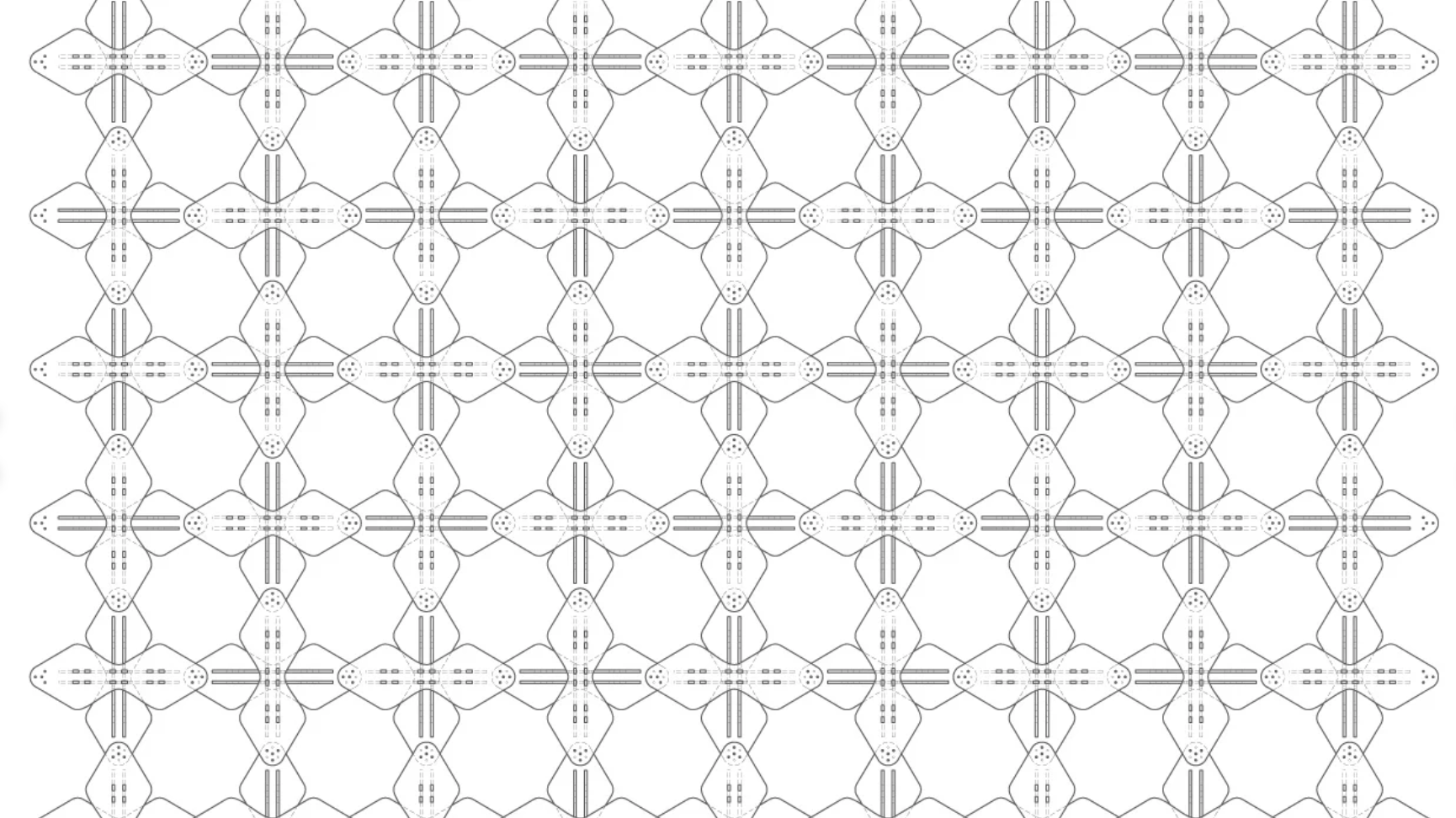
Seven(by)Five linkage schematic
Plan-view schematic of the expandable Cartesian grid linkage, showing the repeating unit cell geometry with ball-and-socket nodal connections.
Team
Phillip Ewing, Anirudh Sharma, Georgios Samartzopoulos
Supervisor
Prof. Erik Demaine, MIT CSAIL, Chuck Hoberman

Building skins are static. They cannot respond to sun angle, wind load, or acoustic conditions after installation. We asked: can a single surface simultaneously scale in-plane and bend out-of-plane, controlled by sensors, to modulate light, airflow, and sound in real time?

The starting point is Chuck Hoberman's expandable Cartesian grid linkage — a planar scissor mechanism where rigid links connected at pivot points can uniformly scale. We extended this by replacing pivot joints with ball-and-socket joints, adding 3 rotational degrees of freedom per node. This permits single-curvature (Gaussian curvature K = 0) out-of-plane bending while preserving the in-plane expansion capability.

The surface can be applied as a building facade skin or interior space partition, interacting with temperature, air, and light stimuli. Sensors placed on the surface drive mechanical actuators that force geometric transformation, changing petal density and permeability in response to environmental input.

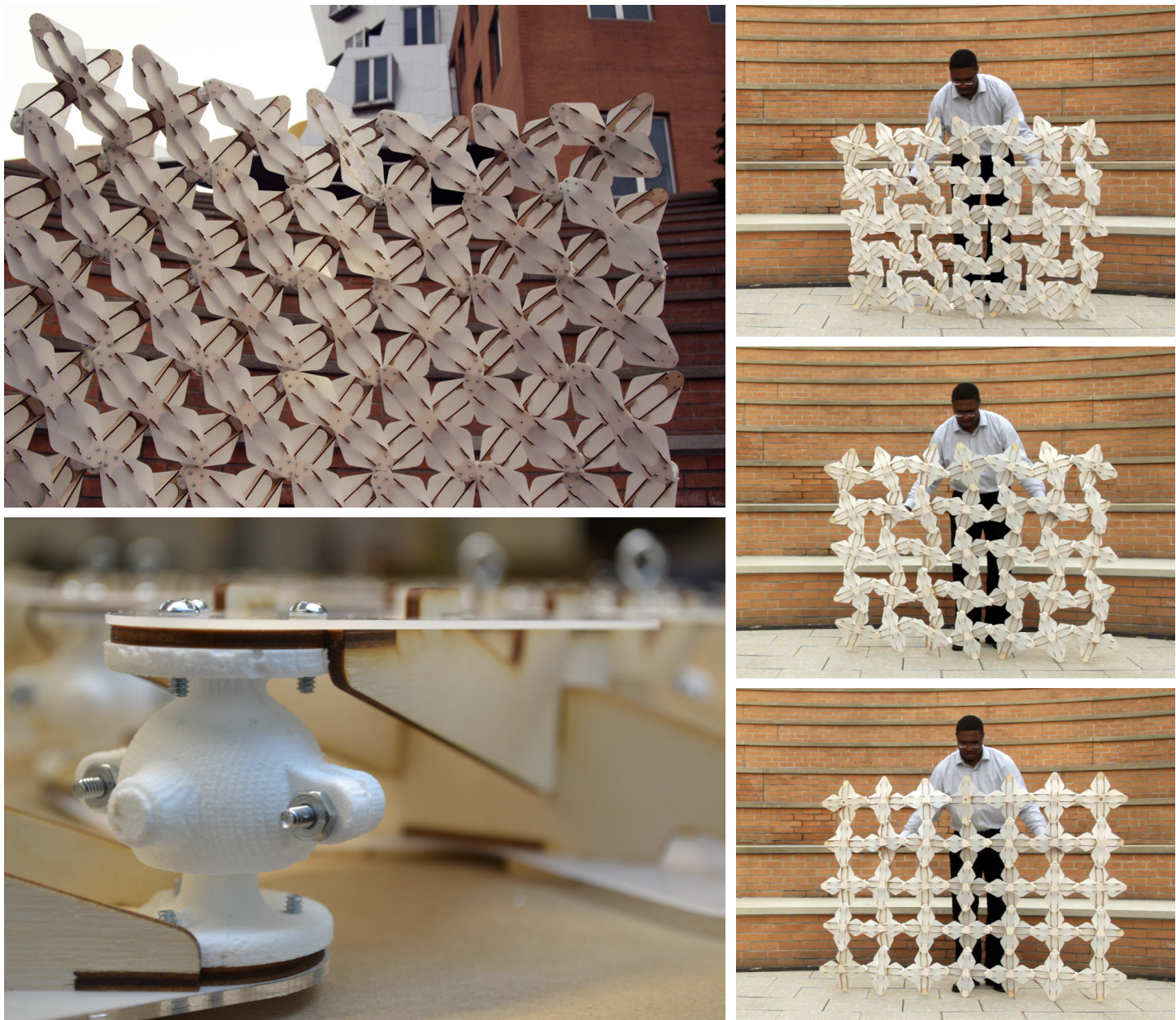
Assembled Seven(by)Five prototype at human scale
Assembled prototype showing the expanded surface at human scale (top left), three actuation states from compact to fully extended (right), and ball-and-socket joint detail (bottom left).

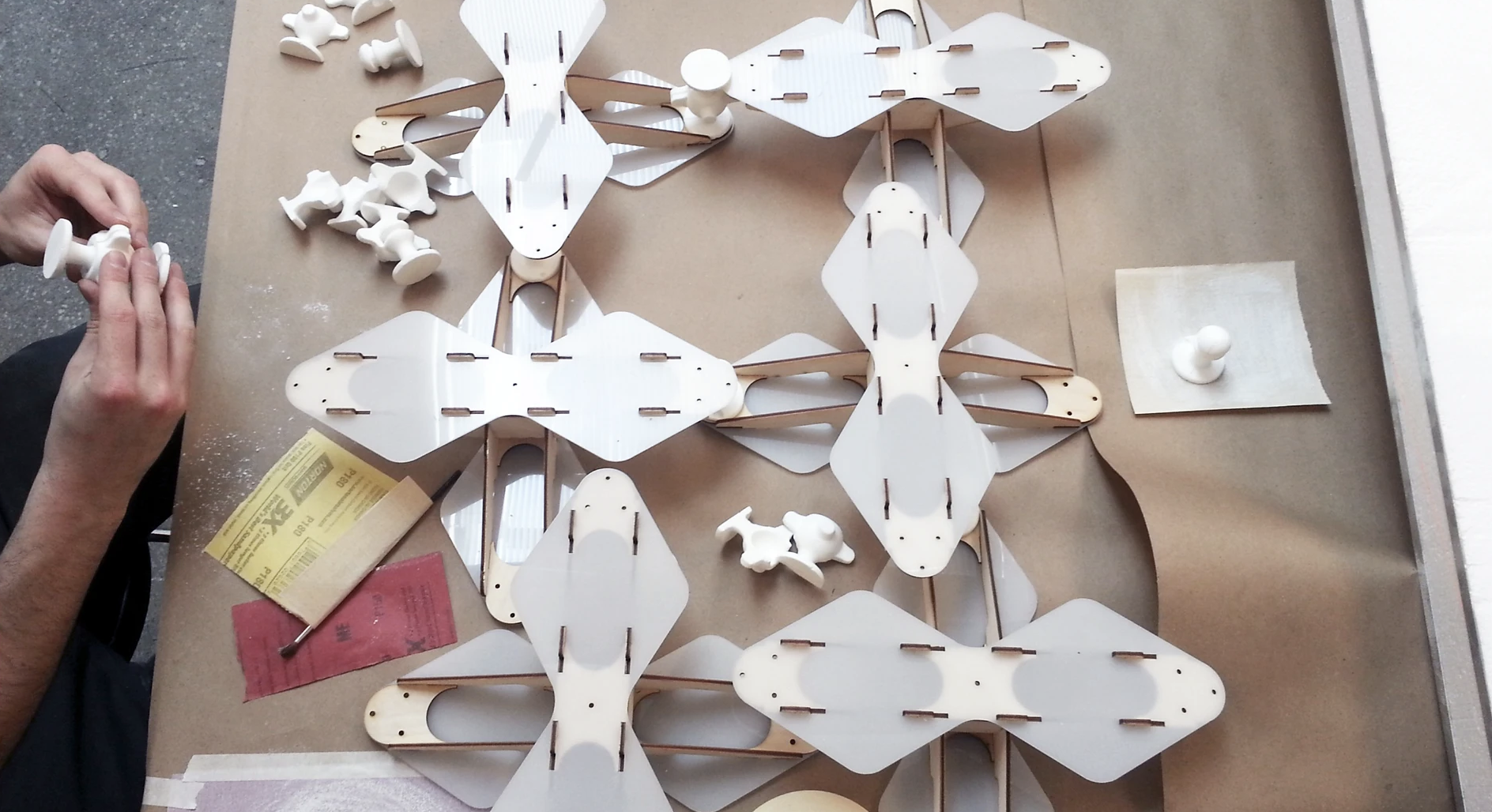
The prototype fabrication process focused on the ball-and-socket joints connecting parts together while allowing specific degrees of freedom. We applied molding and casting techniques using liquid plastics to create the joints. Petal material is PVC on plywood substrates.

We handcast 800 components over 5 days and motorized them.

A working 7 × 5 unit-cell prototype that expands, contracts, and bends into self-supporting curved configurations. As the system actuates, varying petal densities modulate light transmission and porosity — a mechanical scaffold for environment-adapting facades.

Hand-cast components on assembly workbench
Assembly workbench showing hand-cast PVC petal elements on plywood linkage substrates with molded ball-and-socket joints. 800 individual components were fabricated using liquid-plastic casting during a five-day production cycle.

Kinematic Parameters

Parameter Value
Grid topology 7 × 5 Cartesian unit cells
Mechanism type Hoberman scissor linkage (planar scaling)
Joint type Ball-and-socket — 3 rotational DOF per node
Bending constraint Single-curvature (Gaussian curvature K = 0)
Total components ~800 (links + joints + petals ≈ 23 per unit cell × 35 cells)
Petal material PVC + plywood substrates
Joint material Liquid-plastic cast
Fabrication time 5 days, hand-cast + motorized

Each scissor pair in the Hoberman linkage has 1 DOF (uniform planar scaling). By substituting ball-and-socket joints (3 rotational DOF each), the surface gains out-of-plane freedom while constraining to single-curvature bending — the surface can form cylindrical or conical shapes but not saddle geometries (K ≠ 0). The expansion ratio controls petal overlap area, directly modulating light transmission as a function of actuator displacement.